
What makes you happy?
I've started asking strangers this in the middle of runs. Here's what's come back.
- Author:
- William Burnett
- Date:
- August 14 2026
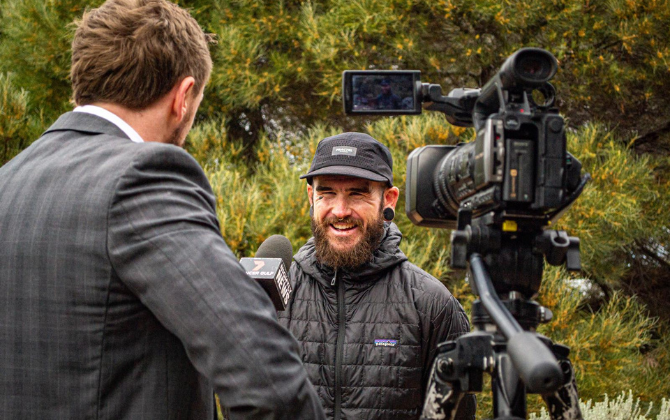
I ask strangers this now, mid-run, sweaty, and usually about four kilometers from anywhere. I know that sounds like the kind of thing a bloke starts doing after a hard year, and honestly, that is not far off. Bit of context, because most of you know We Move to Heal better than you know me. I run, but not the sensible kind where you tick off five kilometers before work and feel good all day. I mean the far end of it, the part shaped by my ultra-running lifestyle, where I ran 81 ultra runs in 81 days from Margaret River to Byron Bay, straight across Australia, with my wife Cas driving a caravan behind me and the kids doing school at the fold-out table inside it.
This year was built around a Western States qualifier. Long hours in the bush, alarms going off before dawn, and training that asked more of my family than it asked of me, because every five-hour run was also five hours where Cas was holding the house together on her own. Then, five weeks ago, I stopped running. What I thought was a niggle turned out to be the end of my season. The qualifier is gone, races are off the calendar, and no, I am not going to call it a gift. I am still annoyed, and I would rather be honest than neat. Which is roughly where I was when that question started to matter.
The theory, such as it is
I've no clean answer to it. What I do have is a hunch, built over a lot of kilometers, that most of us set the thing up backward. Happiness is a bit like trying to remember a word. The harder you push, the further back it goes. You can stand there for a full minute, doing the little finger-point thing, and nothing. Then you are in the shower two hours later, thinking about nothing at all, and there it is, fully formed and slightly smug. So I stopped chasing it. I try to live in the moment and let it find me. It does that far more often than it ever did when I went after it, and this is the part I truly did not see coming: it almost always shows up carrying someone else with it.
Why running, of all things
Not because it beats everything else in my life, because it does not, and my kids would happily set the record straight if you handed them a microphone. It is because running stays neutral. It does not care what mood I arrived in or what I have been telling myself all week. It quietly gives things back: I come home a better version of me, my connection to the people I love gets deeper, it tells me the truth whether I ask for it or not, and it leaks into everything else until that is better too. That is why it works for me as running for mental health and connection: not as a grand theory, but as a steady reset. That is the whole case, and I have gone looking for a more clever one.
The shape of it
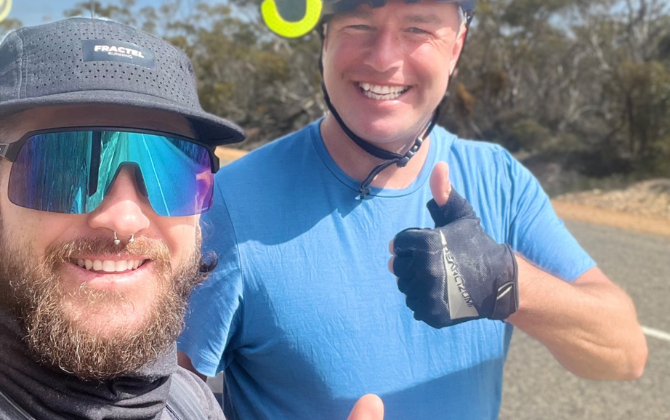
Every run now follows the same six moves: run, notice, stop, listen, smile, share. That is one of my running rituals. Meaning I go out, I notice somebody, and then I actually stop. Not the runner's nod, not the quick hand raises you use to acknowledge another human while making it very clear you have no intention of slowing down. I introduce myself, which is awkward about one time in four, and I have made my peace with that. Then I ask the one question I always ask. We take a selfie, and their smile becomes part of the thing.
I ask that question on purpose. 'How are you?' gets a reflex, because people have answered it ten thousand times without really thinking, and they will happily do it again. 'What makes you happy' has no script attached, so you get to watch someone search for the answer. There is a pause, a slightly startled look, and then something honest falls out, usually smaller and far better than whatever they would have prepared. Dogs come up a lot. So does bread.
Then it stops being mine
Every hundred smiles, the community picks my next hundred kilometers. It could be an organized ultra, a local route, a point-to-point, a Strava segment somebody has had their eye on, or something nobody has thought of yet. I do not get to pick. That sounds like a small mechanic, a bit of choice to make the thing sticky, but it is the whole engine, because the second other people choose the distance, I am no longer tracking something I did and asking you to watch. I am doing something you decided. The arrows point the other way. This is where community running matters most.
Which I have found harder than the running, if I am honest. Ultra runners are control merchants; we plan our nutrition to the gram and our pacing to the second, and then act surprised to find we are bad at surprises. I still want to gently lobby for the route I prefer. I do not. That restraint is the actual discipline here, not the mileage.
The unglamorous reason it has to be hard
I have looked for this in easier spots, and comfort does not produce it. You can be perfectly comfortable and quietly miserable at the same time, and I have managed that on a couch, with good coffee, with everything technically fine. Something shifts when the body is working, and there is no screen in the frame. People stop performing, mostly because putting on a show takes energy they would rather spend on the hill, and a stranger on a trail at six in the morning will tell you things they have never told someone they have known for twenty years. I do not fully understand why. I have just watched it hold up on many Australian roads, and many people who had no reason to stop did anyway.
The effort seems to do the heavy lifting. Not suffering for its own sake, which is a different thing, and a worse one, and there is plenty of it about, but effort strips a layer away, and whatever is underneath is suddenly within reach for both of you at once. Nature does something similar, and I understand that even less. Run the same conversation in a café, and it comes out shorter every time.
What the injury actually took
Here is the bit I would rather skip, so let us be quick about it. I lost the season, I am disappointed, some days I am properly angry, and I would rather have the year back. But the noticing did not stop, and neither did the stopping, or the question, or the smiles, which has been a bit humbling, because it means the part I actually needed was never the mileage. The mileage was the excuse that got me out the door and near other people. Progress this year has meant having the discipline to stop, and I want it on the record that I did not want that lesson, and I am still arguing with it most mornings. That is part of my running injury recovery.
If you see me
I am not asking you to sign up for anything, and there is nothing to click. But if you see me out there, sweaty, probably talking to a stranger, and quite possibly limping at the moment, stop me and tell me what makes you happy. I will take the photo, and somewhere down the line, a hundred people I have never met will decide where I run next. That is the whole thing. It just takes someone being willing to stop, and it might as well be me first.
Are you ready to take the journey?
Take the journey and find your nature guide.