
Before You Change Anything, Breathe
You’re not going to think your way out of chronic stress. Here's how you can use your body instead.
- Author:
- Bob Soulliere
- Date:
- October 26 2026
There is a particular kind of exhaustion that comes from sitting perfectly still. You have answered the emails, closed the laptop, and finally reached the part of the day when nothing is being asked of you. Yet your jaw is tightening, your shoulders are raised, and some part of you is still preparing for an argument. You tell yourself to relax, and the instruction lands like another assignment.
This is where I want to begin. Not with a better morning routine or a more disciplined attitude, but with the possibility that you are asking your thoughts to do a job your body needs to help with. We tend to treat stress as a problem of interpretation: Change the story, practice gratitude, get some perspective. Sometimes those things help. But before you try to reconsider a situation, it is worth noticing the condition in which you are considering it. Are you breathing easily? Are you braced? Have you spent the afternoon preparing for danger while calling it productivity?
My work starts with a simple proposition: Your experience of life is inseparable from the nervous system through which you experience it. That does not mean your problems are imaginary, or that a different attitude would make them disappear. It means that the problem and the state you bring to it are not quite the same thing. You may not be able to change the problem, but you can change your state.
The body gets a vote
When people hear “breathwork,” they often imagine something separate from ordinary life: a class, a mat, an intense experience involving dramatic breathing and an equally dramatic revelation. What interests me, though, is less impressive to watch. It is how you breathe while reading an email, washing a cup, or listening to someone you love say something you do not want to hear. Those are the moments when a practice becomes useful or remains something you did once in a workshop.
Breathing usually happens without your attention, but it is also something you can influence deliberately. That makes it a useful meeting point between what your body does automatically and what you can choose to do. Research gives us reasons to take that possibility seriously, though not to turn it into a promise. A review of 31 studies involving 1,133 participants found that slow-paced breathing produced immediate changes in several cardiovascular measures, including heart rate and heart-rate variability. Evidence for reducing negative emotion, including perceived stress, was more modest. The distinction matters: a measurable physical change is not the same as a guarantee that you will feel better.link.springer
Breath provides influence where you thought you had none, and that is worth discovering, especially on days when everything else feels beyond reach. I am not asking people to believe that breathing will solve their problems. I am asking them to notice whether their breathing is helping them stay present with those problems.
“Deep” does not mean “more”
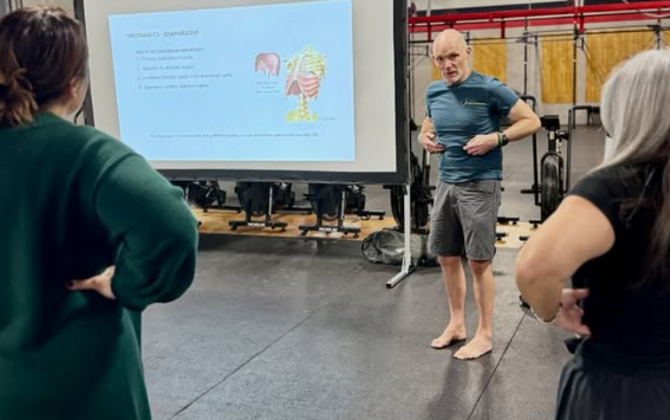
The foundation I teach is what I call functional breathing: breathing suited to what you are doing. I describe the practice in three words: light, slow, deep. Light means unforced, without trying to fill yourself to capacity. Slow means allowing an easier rhythm, not turning slowness into another test you can fail. Deep is the word most likely to be misunderstood. In this practice, it is a cue to breathe through your nose if at all possible, and to stop hauling the breath into raised shoulders and allow comfortable movement around the lower ribs and belly. It is not an instruction to take the biggest breath possible.
That distinction between ease and effort is important because even an instruction as innocent as “take a deep breath” can become one more thing a conscientious person tries to do exceptionally well. The shoulders lift, the chest strains, and relaxation becomes a performance. You are doing more work in the hope of feeling less burdened. What I want people to explore is the opposite: whether they can stop adding unnecessary effort to something their body is already doing.
The same principle shapes the practice itself. I begin with awareness, then softening, then a gentler breathing rhythm. First, notice where you feel your breath moving. Does it seem hurried? Are you holding it while you concentrate? There is no good score here; you are gathering information. Next, see whether your jaw, shoulders, or belly can soften a little. Close your mouth and breathe through your nose. Only then experiment with the rhythm, allowing the next breath to come without forcing it, and the breath out to be a little less hurried, if that feels comfortable.
You do not have to count or hold your breath. You do not have to produce a particular feeling. After a few comfortable breaths, notice again. Perhaps something shifts, or perhaps nothing obvious happens. Neither result is a verdict on you. A single breath is an opportunity to observe, not proof of a cure. Breath-focused relaxation also does not suit everyone in every moment; some people experience increased anxiety or distress during relaxation practices. If paying attention to your breathing makes you feel worse, stop rather than push through.nccih.nih
The lesson I want people to leave with is choice. There is a considerable difference between “I should be able to calm myself down” and “I can investigate what helps.” The first can become another accusation. The second leaves room to learn. Curiosity is your birthright. Use it.
Give the mind a different job
Your mind is a dog. It needs a job. Without direction, it chews through everything in reach: tomorrow’s meeting, yesterday’s conversation, the message nobody has answered. Telling it to stop being a dog won’t help. Give it a job. For a moment, that job can be noticing the next breath, recognizing that your shoulders have climbed again, or catching yourself rehearsing a confrontation while standing alone in the kitchen.
The job is not about emptying the mind or declaring every uncomfortable thought a problem. It is about giving attention to something useful. Instead of arguing with yourself about why you are tense, you can become curious about what the tension feels like and whether anything changes when you stop adding to it. What happens when you release your jaw? What happens when you stop forcing the inhale? Just notice. No judgment.
I encourage people to treat this as an experiment rather than a discipline they must master. There is already enough pressure in most people’s lives. Turning the breath into another standard to fall short of misses the point. The aim is not to become someone who never reacts. It is to become someone who sometimes notices the reaction early enough and, more and more so, chooses what happens next.
A breath will not fix a broken workplace
A breathing practice cannot make an objectively unreasonable workload reasonable. It cannot substitute for medical care, repair an unsafe relationship, or give an exhausted parent the support they have been denied. Advice about coping is not an excuse to avoid changing the conditions people are coping with. The person struggling to get through the day may need more than a technique. They may need help, protection, rest, or a different set of circumstances.
But the opposite mistake is to dismiss a small, available action because it cannot solve a large problem. Sometimes you need to leave, sometimes you need support, and sometimes you need to say something difficult and true. A little more steadiness may help you recognize which. That is the purpose of this practice: not to make you endlessly tolerant, and not to teach you to endure what ought to change, but to help you arrive at the next decision with more room around it.
So before you send the message, agree to the obligation or decide that the whole day is ruined, notice how you are breathing. Let one breath be easier, if you can. The email will still be there. The difficult conversation may still need to happen. You have not made the problem disappear, but you have given yourself a moment in which responding does not have to mean reacting. From there, you can decide what needs to change.
Bob Soulliere is an Oxygen Advantage Master Instructor and a Wim Hof Method Level 2 Instructor. Hear the full episode on the Ground Work podcast.
The practice at a glance
BEFORE YOU CHANGE ANYTHING, NOTICE
│
▼
- BECOME AWARE
Where do I feel my breathing?
Am I rushing, holding, or forcing?
Observe without grading yourself.
│
▼
- SOFTEN THE EFFORT
Can my jaw, shoulders, or belly
Release a little tension?
Allow, rather than force. Close your mouth. Breathe through your nose.
│
▼
- EASE THE RHYTHM
LIGHT → Unforced, not oversized.
SLOW → Less hurried, not strained.
DEEP → Comfortable movement around
lower ribs and belly,
not the biggest breath possible.
│
▼
- NOTICE WHAT CHANGED
Do I feel any different?
Is there more room to choose
How do I respond?
│
▼
- TAKE THE NEXT STEP
Respond, set a boundary, seek help,
rest, or change what needs changing.
THE MAIN LESSON
Breathing can create room to respond.
It does not remove the problem or
create an obligation to feel calm.
If focusing on your breathing increases
If distressed, stop the exercise. And take a break. You are always in control.
Are you ready to take the journey?
Take the journey and find your nature guide.